
QRISE Center
Quantum Hackathon 2026
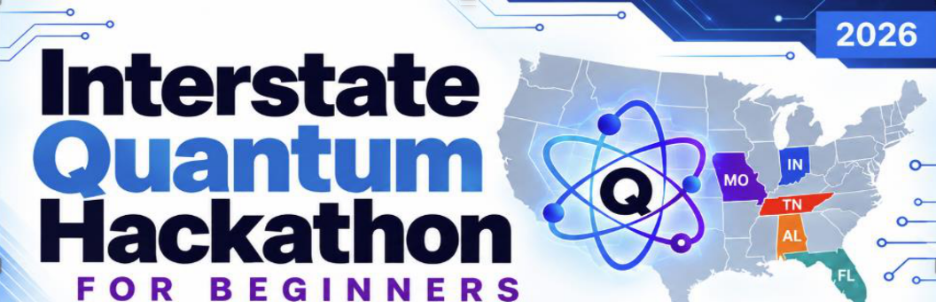
Interstate Quantum Hackathon for Beginners 2026
The Interstate Quantum Hackathon for Beginners is a hands-on, three-day event where undergraduate students, graduate students, and working professionals come together to explore the exciting world of quantum computing. Working in teams of two to four, participants will learn the basics of quantum computing through pre-hackathon online training, develop quantum programs with hands-on Qiskit, and run their ideas on quantum simulators.
No prior experience with quantum computing is required. If you have a basic working knowledge of Python and are curious about how quantum computers work, you have everything you need to get started.
| Dates | October 22–24, 2026 (kickoff Oct 22 at 5:00 PM CDT; closing ceremony Oct 30) |
| Format | Hybrid: at partner institutions and online via Zoom |
| Who | Beginners welcome! Undergraduate students, graduate students, and working professionals |
| Team size | 2–4 people |
| Registration | Open Sept 24 – Oct 4, 2026 |
Register to participate: Registration form | Download the flyer
Participating institutions
Teams are forming now at these partner institutions from Tennessee, Indiana, Missouri, Alabama, and Florida. Studying or working somewhere else? Register anyway, independent participants and mixed-institution teams are welcome.

Sponsors
This event is supported by the National Science Foundation (NSF) and Middle Tennessee Electric, and is part of Qiskit Fall Fest 2026.
Agenda
Training sessions run online before the hackathon. All times are Central Daylight Time (CDT).
Before the Hackathon
| When | What |
| Sept 24 – Oct 4 | Registration open |
| Oct 9 and Oct 16, 12:00–1:30 PM CDT | Online training sessions (Quantum basics, Qiskit, VQE, QML) |
Hackathon Week
| When | What |
| Oct 22, 5:00–6:30 PM CDT | Launch & project selection |
| Oct 23, 5:00–6:30 PM CDT | Keynote industry talk |
| Oct 24, 9:00 AM – 4:00 PM CDT | Hacking, project submission, presentations & judging |
| Oct 30 | Closing ceremony |
This year’s challenges
This year’s hackathon features three challenges:
| Challenge | Description |
| VQE for Chemistry & Materials | Quantum algorithms for molecular and materials problems. |
| Quantum Machine Learning | Build a quantum/classical model for real-world data problems. |
| Optimization for Energy & Grid | Quantum algorithms for optimization problems in energy systems and the electric grid. |
The goal is to build a functional prototype that runs on a quantum simulator, with bonus points for anything that also runs on real quantum hardware. The full brief — problem statements, starter notebooks, and judging criteria — is published in the challenge repository.
Judging weighs technical depth, creativity of the approach, and how clearly the team can explain what their quantum implementation improves upon the given prototype.
| Implementation | Noiseless and noisy hardware implementations |
| Awards & perks | Awards for the top three teams, plus food and stipends. All participants receive an IBM Certificate of Participation and an MTSU badge. |
View the challenge brief (Inactive)
Keynote Speaker
Our keynote speaker will share insights on the latest developments in quantum computing and how they are shaping the future of the field.
Name of the keynote speaker and details will be announced soon.
Organizers & mentors
The people running the event, your point of contact at each partner institution, and the mentors who’ll be on the floor throughout the event to help teams get unstuck.
Executive Committee
Hanna Terletska, MTSU | David Liu, Purdue University-Fort Wayne | Abhijit Chakraborty, MTSU |
Organization Committee
| John Villanova MTSU | |||
Mentors
Suggested reading
Nothing here is required before you arrive — the Friday workshops start from first principles. These are just good places to look if you want a head start or want to go deeper after the event.
Foundations
- Quantum Computation and Quantum Information — Michael A. Nielsen and Isaac L. Chuang — the standard graduate reference
- Quantum Computing: An Applied Approach — Jack D. Hidary — a gentler, code-first introduction
Hands-on tools
- IBM Quantum Learning — Free courses covering Qiskit, circuits, and quantum algorithms
- PennyLane — Quantum machine learning library, with a codebook and demos
- Azure Quantum Katas — Self-paced exercises for learning quantum programming
Papers and talks
- Quantum Computing in the NISQ Era and Beyond — John Preskill, 2018 — why near-term quantum hardware is hard and interesting
- Quantum Supremacy Using a Programmable Superconducting Processor — Arute et al., Google AI Quantum, Nature 2019
Contact
Questions? Contact Hanna Terletska at hanna.terletska@mtsu.edu and Abhijit Chakrabarty at abhijit.chakrabarty@mtsu.edu

Contact

Hanna Terletska
Director of QRISE Center
Associate Professor
Department of Physics & Astronomy
WPS 206C
Phone: 615-898-2792
Email: hanna.terletska@mtsu.edu