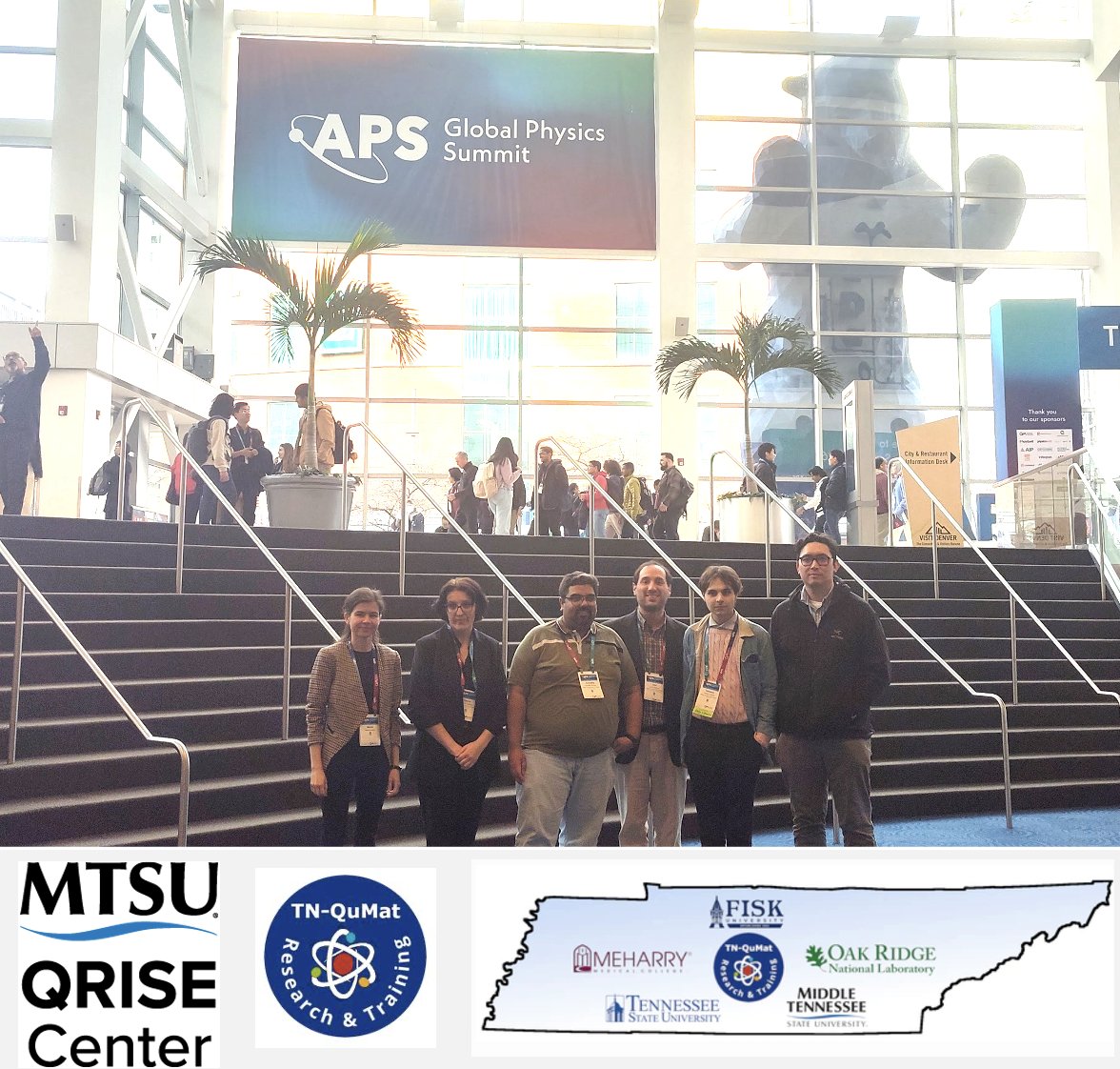
The APS Global Physics Summit, the joint 2026 March and April Meeting of the American Physical Society, gathered more than 14,000 physicists from around the world at the Colorado Convention Center in Denver. It is the largest annual physics conference in the world.
MTSU’s QRISE Center brought nine presentations to the summit, with the team led by Dr. Hanna Terletska and Dr. John Villanova. The contributions included two undergraduate students, two graduate students, three postdoctoral researchers, and two faculty members. This work, supported by the National Science Foundation and the U.S. Department of Energy’s Office of Basic Energy Sciences, spans theoretical, computational, and first-principles approaches.
The presentations covered the full breadth of QRISE’s research portfolio, from quantum materials theory and machine learning-accelerated simulation to quantum algorithms, quantum photonics, and next-generation magnetic and superconducting materials.
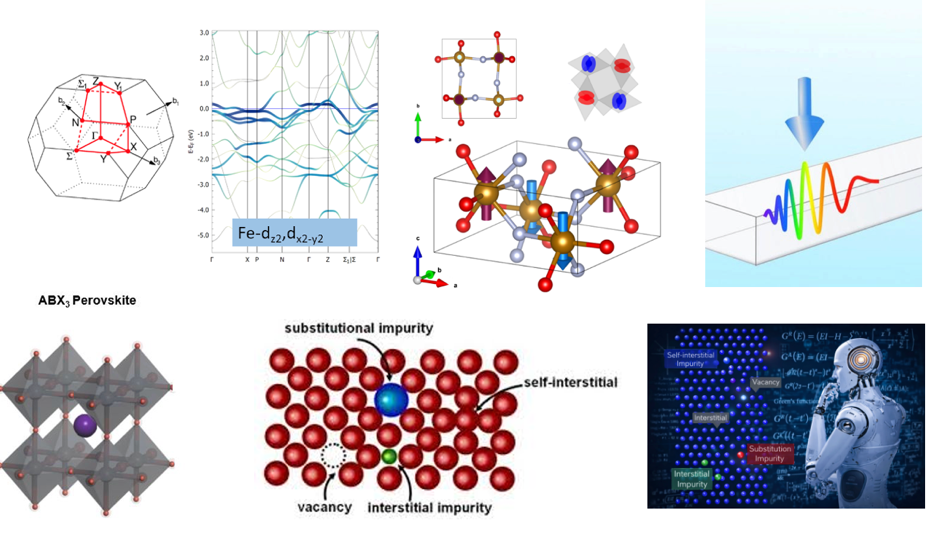
Quantum materials with strong correlation and disorder are at the heart of some of the most consequential open problems in modern physics, from high-temperature superconductivity to quantum computing hardware. Understanding when and why these materials conduct or insulate, and how that behavior evolves far from equilibrium, is directly relevant to the design of next-generation quantum devices. This thread runs through the work of Terletska, Wong, and Mirmira (NSF DMR, DOE BES, DOE RENEW/TN-QuMat), with methods ranging from large-cluster DCA to non-equilibrium many-body approaches.
The quantum algorithm work (Hanna Terletska and Mariia Karabin, with ORNL) extends this directly into quantum computing, benchmarking impurity solvers that are essential building blocks for running correlated materials calculations on quantum hardware, carried out in collaboration with ORNL researchers through the TN-QuMat program.
Another topic presented includes, altermagnetism which is a newly recognized magnetic phase that combines properties of ferromagnets and antiferromagnets in ways previously thought impossible, producing large spin-polarized currents without a net magnetic field, making it highly attractive for next-generation spintronic devices and quantum sensors. Undergraduate student Cameron Morelli, in collaboration with Dr. John Villanova, presented first-principles studies of altermagnetic and Villanova presented additional project on unconventional superconducting materials (DOE RENEW / TN-QuMat Program), positioning MTSU at the forefront of this rapidly developing field.
Machine learning is embedded in QRISE’s methodology both as a standalone prediction tool and as a means of accelerating simulations that would otherwise be computationally intractable. Karabin’s work on hybrid metal halide perovskites – candidates for more efficient solar cells — demonstrates how ML can predict material properties from chemistry alone, without expensive trial-and-error synthesis (NSF DMREF). Mondal and Terletska apply ML acceleration to quantum many-body simulation itself (NSF DMR), pushing the frontier of what is computationally reachable.
Quantum emitters – individual quantum systems that emit light one photon at a time — are the building blocks of quantum communication and photonic computing. George’s work (NSF ExpandQISE) characterizes how coupled emitters behave under realistic driving conditions, essential for designing reliable single-photon sources.
Several of these projects are conducted in collaboration with researchers at Oak Ridge National Laboratory, including Thomas Maier, Tom Berlijn, Markus Eisenbach, whose partnership with MTSU, formalized through the TN-QuMat DOE RENEW initiative, supports both the computational infrastructure for large-scale simulations and a workforce development pipeline connecting MTSU, Fisk University, Tennessee State University, and Meharry Medical College with DOE national laboratory science.
The research presented at the APS Global Physics Summit was supported by the National Science Foundation (awards including NSF CAREER, NSF DMREF, and NSF ExpandQISE) and the U.S. Department of Energy Office of Basic Energy Sciences. QRISE’s active federal quantum research portfolio exceeds $8.5 million in NSF and DOE funding.
By Hanna Terletska